
The Architecture of Commitment:
Why Engagement is a Business Survival Engine, Not an HR Program


Across the global enterprise landscape, corporate boards and executive leadership teams are confronting an increasingly expensive paradox. Despite unprecedented capital investments in flexible work models, technological infrastructure, and modern employee experience initiatives, organizational commitment remains dangerously fragile. Talent mobility has broken through historic thresholds; even professionals categorized as actively engaged are fundamentally reevaluating what their relationship with their employer means.
The critical question confronting modern executive leadership is no longer whether their workforce is executing daily tasks—it is explicitly why they choose to stay tomorrow. For too long, enterprise organizations have delegated employee engagement to administrative human resources functions, treating it as a soft morale metric or a collection of cultural benefits. This represents a major strategic blind spot. To map the precise forces that anchor human capital within modern enterprises, a comprehensive global study evaluated over 60,000 corporate voices across diverse industries, geographies, and demographics. The empirical data thoroughly dismantles the myth of engagement as an administrative program, exposing it as an absolute business survival engine and a core driver of asset appreciation.
1. The Macroeconomics of Human Capital
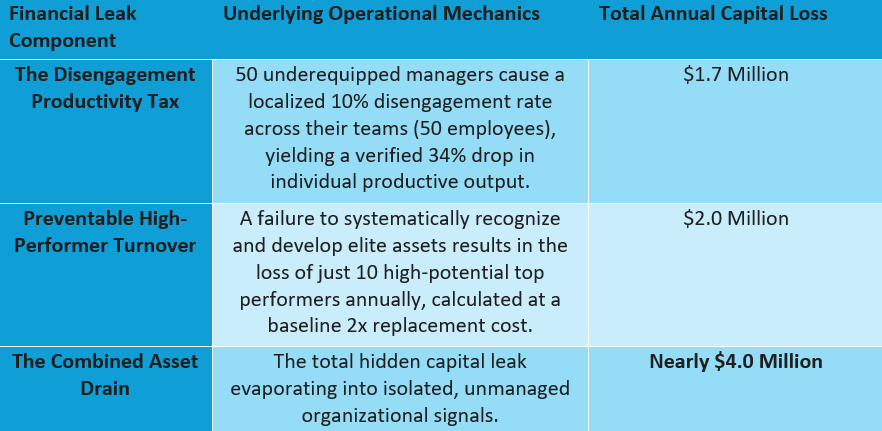
When senior leadership fails to systematically measure and connect the signals of human commitment, the financial penalties exact a severe, unindexed toll on the corporate profit and loss statement. High-performing elite assets generate between 400% and 800% of the productive output of an average employee. Yet, shockingly, only 57% of enterprise organizations maintain a formal process to accurately identify and cultivate this high-potential segment. When these critical contributors go unrecognized, underdeveloped, or unsupported, they quietly transition into severe retention risks—an event that costs between 1.5x to 2x their annual salary to replace.
To understand the baseline macroeconomic scale of this issue, consider an enterprise model of an organization with 2,500 employees, 250 managers, and an average employee salary of $100,000. The real cost of disconnected data and underequipped leadership can be mathematically modeled across two distinct financial leaks:
The Human Capital Leakage Model
2. The Metrics Paradox: A Tale of Two Managers
The primary reason these multi-million-dollar financial drains go unnoticed is that traditional corporate dashboards look at disconnected, superficial metrics. When leadership manages an organization through isolated data points, they are highly susceptible to making disastrous talent, promotional, and development decisions. This organizational paradox is clearly illustrated by evaluating two peer managers with comparable tenures and similarly sized teams: Manager Alex and Manager Jordan.
The Disconnected View
On a standard quarterly human resources dashboard, Alex looks like an elite leader. His team’s engagement scores are climbing, internal performance ratings are strong, and he has logged a pristine 0% attrition rate over the past 18 months.
Jordan, conversely, looks like a critical operational problem to be corrected. Her team’s engagement scores fluctuate significantly, performance ratings are highly mixed, and she has suffered a 21% attrition rate over the same baseline period.
Traditional corporate structures yield a swift and profoundly flawed executive verdict: reward and promote Alex, and put Jordan on a strict performance improvement plan.
The Connected View
When an organization integrates its behavioral data—cross-referencing 1:1 notes, peer feedback, strategic goal completion rates, and cross-functional recognition—the true reality of the enterprise valuation emerges:
● Alex represents a catastrophic operational risk. His team’s high output is sustained entirely by Alex carrying the workload himself because his direct reports are fundamentally unready to step into responsibility. Cross-functional stakeholders and external peers rate his team poorly; feedback reveals that expectations are routinely missed, and recognition is almost exclusively self-generated within his own silo. More importantly, a connected text analysis reveals that explicit burnout language within Alex’s team communications has tripled over the last two quarters. Alex is a severe flight risk; if he resigns, his entire department collapses into an immediate talent void.
● Jordan is executing a masterclass in elite asset optimization. A connected analysis of her 21% attrition reveals that the departures consisted exclusively of chronic low performers who were actively and correctly managed out of the business. Meanwhile, her high-potential top performers are being retained at rates that comfortably eclipse the corporate average. Recognition for her team flows natively from external cross-functional units and is explicitly tied to closing, launching, and delivering critical corporate outcomes. Most importantly, Jordan’s team is consistently chosen for the enterprise’s most critical strategic initiatives, completing complex goals at rates that crush both internal and external benchmarks.
Without connecting the signals across systems, executive leadership will systematically reward the leader who is burning out and punish the leader who is driving long-term enterprise valuation.
3. The Mathematical Architecture of Retention
Human commitment is not an abstract variable; it is a highly predictable mathematical ecosystem. By calculating cross-sectional correlation coefficients alongside predictive risk ratios across 60,000 global voices, the data isolates the exact behavioral levers that directly anchor or erode professional loyalty.
To provide C-suite leaders with actionable visibility, these top 10 empirical drivers are structured below into three core pillars of enterprise stability:
Pillar I: Growth & Development Performance
● Managerial Investment in Growth (r = 0.68): Multiplies an employee’s likelihood to stay by 25 Times. Leadership development is the single strongest statistical predictor of workforce retention globally. When a manager fails to actively discuss development, the organization incurs an immediate 2,500% increase in baseline retention risk.
● Visible Career Progression Pathways (r = 0.52): Multiplies retention likelihood by 9 Times. Transparent, intentional horizontal or vertical growth tracks dramatically reduce regretful voluntary turnover.
Pillar II: Trust & Culture Alignment
● Organizational Pride and Peer Advocacy (r = 0.65): Multiplies retention likelihood by 19 Times. A willingness to recommend the enterprise as an elite workplace is a pure reflection of systemic belonging and trust.
● Inspirational Motivation and Purpose (r = 0.61): Multiplies retention likelihood by 14 Times. Purpose actively fuels discretionary execution; highly energized employees stay.
● Absolute Trust in Direct Leadership (r = 0.55): Multiplies retention likelihood by 10 Times. Trust in immediate leadership anchors engagement and dampens the desire for external talent mobility.
● Transparent Leadership Communication (r = 0.49): Multiplies retention likelihood by 8 Times. Open, proactive communication from senior executives removes operational uncertainty and builds corporate alignment.
●
Pillar III: Operational Environment & Ecosystem Health
● Systemic Performance Recognition (r = 0.59): Multiplies retention likelihood by 12 Times. Equitable and visible recognition directly builds long-term corporate identity and professional loyalty.
● Systemic Respect and Safety (r = 0.45): Multiplies retention likelihood by 6 Times. A respectful environment serves as the foundational barrier against localized cultural decay and protects physical and psychological safety.
● Cross-Functional Team Cohesion (r = 0.42): Multiplies retention likelihood by 5 Times. Seamless peer-to-peer collaboration and high trust sustain daily workforce engagement under intense market pressures.
● Sustainable Workload Management (r = 0.40): Multiplies retention likelihood by 4 Times. Protecting manager and team capacity directly prevents acute burnout and unpredictable, catastrophic exits.
4. The Engagement Flywheel™ and Its Structural Breaks
The empirical findings demonstrate that human capital optimization cannot exist in corporate silos. Retention is not an additive equation; it is a dynamic, self-reinforcing, continuous cycle known as The Engagement Flywheel™.
When executed correctly, individual Motivation inspires deep Personal Pride. Pride transforms natively into organic, high-impact Genuine Advocacy. Advocacy deepens cross-functional community Trust, which directly secures Exponential Retention. Higher retention preserves critical institutional knowledge and yields exceptional Business Performance, seamlessly restarting the flywheel at an elevated corporate scale.
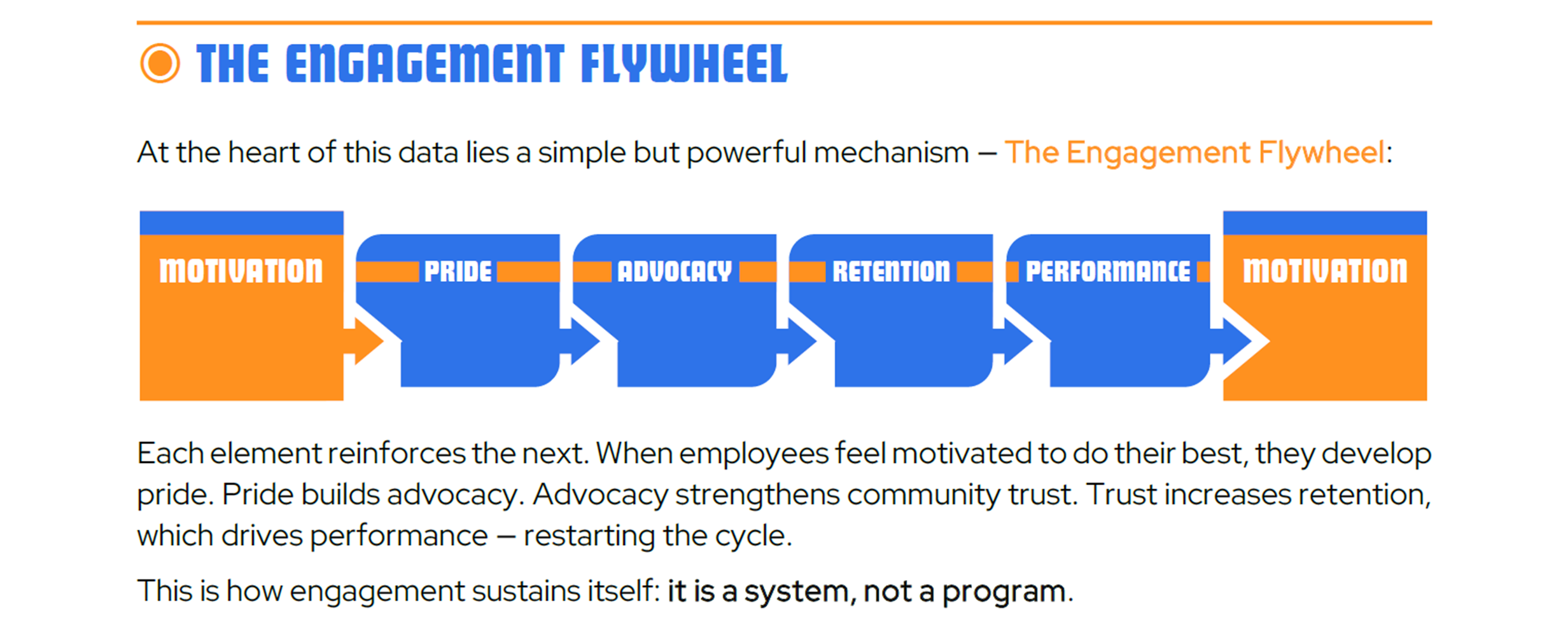
However, this flywheel is highly sensitive to management misalignment. Diagnostic data indicates that enterprise momentum typically stalls or breaks down at three specific structural intersection points:
Breakpoint 1: The Burnout Trap (The Motivation-to-Pride Break)
● The Symptom: Maximum individual worker effort coupled with low organizational loyalty and high flight risk.
● The Root Cause: Employees are highly motivated to deliver results but lack the systemic fairness, recognition equity, and inclusive leadership required to build genuine corporate pride. This operational break is severely exacerbated by the fact that the average corporate manager currently carries 51% more operational responsibility than they can effectively manage, crushing their capacity to coach their teams.
Breakpoint 2: The Silent Culture (The Pride-to-Advocacy Break)
● The Symptom: Personally satisfied employees who completely refuse to refer elite external talent or advocate for the corporate brand.
● The Root Cause: A fundamental deficiency in psychological safety. Advocacy requires the absolute confidence to speak openly and take calculated risks without fear of executive retribution. If professionals respect their immediate tasks but fear the opacity or internal politics of senior leadership, they will remain completely silent, choking off the company’s most powerful organic recruitment engine.
Breakpoint 3: The Dead End (The Advocacy-to-Retention Break)
● The Symptom: A phenomenal, highly celebrated corporate culture paired with unexpectedly high voluntary turnover among mid-tenure assets.
● The Root Cause: Stagnant vertical and horizontal progression pathways. Even the most passionate brand advocates and cultural champions will eventually leave the organization if they cannot explicitly visualize an intentional, long-term future for their own career trajectory.
5. The Proven Valuation Lever: A $310 Million Strategy Case
To understand how a data-driven focus on the connected levers of commitment directly influences corporate valuation and asset appreciation, look to the software sector.
Situation & Complication
A pioneering digital security firm executed a complex asset acquisition, purchasing a massive competitor’s division for $60 million. This transaction created an immediate corporate crisis: the acquired assets generated the vast majority of enterprise revenue yet operated as an isolated subsidiary with nonexistent HR infrastructure, rampant cultural fragmentation, and severe operational silos. Employee sentiment quickly plunged into a deep crisis regarding direct supervisors, development pathways, and leadership credibility, severely threatening retention and triggering sharp stock volatility.
The Resolution Blueprint
Rather than deploying short-term administrative benefits, senior leadership launched a comprehensive operational intervention driven strictly by employee feedback data:
● Radical Behavioral Transparency: Instead of hiding the negative data, leadership went fully public with the critical feedback, presenting areas of concern directly to the workforce and actively utilizing cross-functional focus groups to restructure operational behavior.
● Operationalizing Core Values: The enterprise established core cultural values that were deeply embedded in every operational matrix. In recruiting, candidates were rigorously assessed against behavioral values before an offer was extended. In performance management, employee reviews were heavily weighted against explicit value-driven behaviors and Balanced Scorecard contributions.
● Manager Accountability and Re-Skilling: Partnering with specialized leadership experts, the firm launched aggressive development curricula for current and future supervisors, utilizing comprehensive 360-degree feedback loops. Senior executives were required to step out of headquarters to run transparent, informal dialogue sessions with the field. Most critically, leadership enforced a strict “three-strikes” accountability framework for the executive suite: any leader who drifted from the core organizational values was provided a warning, then a coach, and then promptly exited the firm.
The Valuation Result
The strategy shifted from tracking passive engagement metrics to executing precise, data-driven management adjustments. By stabilizing their human capital asset, eliminating internal operational friction, and positioning the direct manager as the core leverage point for retention, the firm engineered a massive operational turnaround.
The investment triggered a remarkable $10 million positive swing in corporate profitability within twelve months. More importantly, the cultural optimization completely stabilized the volatile asset, allowing the enterprise to successfully execute an elite exit, selling the optimized business division for $310 million cash, returning an extraordinary multiple on their initial $60 million purchase price.
Conclusion: The Strategic Differentiator
The data gathered from over 60,000 global corporate voices delivers an undeniable truth for modern executive leadership: human capital investment is the ultimate engine for sustainable corporate performance, asset stabilization, and value creation. Professionals do not maintain long-term commitment to an organization merely because they are handed a transactional paycheck. They stay where direct managers actively cultivate their growth, where leadership communication replaces uncertainty with radical transparency, and where corporate values manifest in daily management behavior.
In the modern enterprise economy, data-driven engagement is no longer a passive human resources metric; it is the definitive strategic lens through which corporate innovation, performance stabilization, and enterprise culture intersect to build a compounding competitive advantage.