
Everyone Grows in the Rain
Stop Running for Cover


The Pressure to Look Good
I have failed. I have fallen short. I have made mistakes. And I am better off for it.
Many of us were raised with a hidden, destructive rule: you have to look good. We are taught from an early age to protect our image, project constant success, and avoid anything that might make us look foolish. This social conditioning quietly forces us onto the safe path. We opt for predictability because the alternative, discomfort and failure, feels far too painful.
For many people, a single major setback becomes a permanent residence. They get stuck living in the pain of what went wrong, or they spend the rest of their lives avoiding risk at all costs to ensure they never feel that sting again.
But hiding from the storm comes at a massive cost.
Everyone grows in the rain, but only if they choose to stand in it.
The Myth of the Smooth Ride
From the outside, it is easy to look at someone else’s career and assume their ride was perfectly smooth. My own journey might look that way to a casual observer, but I got where I am because I took risks, educated risks. I did not choose the safe route. The truth is, because of my risk tolerance, my path has been filled with mistakes, failure, and some deeply scary moments.
My brother, Keith, knows this because he has seen it firsthand. He has watched me fall, but he has also long said that he admired my ability to come back, to stand up right after hitting the ground.
I know what it feels like when the ground gives way.
I have been laid off.
I have been asked by a major client not to return.
I invested heavily in my business right before the 2008 financial crash, a specific time when cash flow was more important than ever.
Those moments were uncomfortable, some terrifying. But somewhere along the way, I refused to ignore those painful moments, and I refused to succumb to them. I chose not to live there in those failures either. Instead, I chose to stand in them, explore them, face them, and learn from them. Keith often jokes that I have an uncanny ability to make lemonade out of lemons.
In the end, navigating the storm has always been about activating my ultimate superpower: Choice.
In our worst moments, we still retain the power to choose. No one can take that away from you. My choice has been to problem-solve and learn. When things go wrong, I immediately ask myself a set of distinct questions.

Those moments, my mindset, and those questions have catapulted me to better places, improved my skillset and knowledge, and now allow me to tackle challenges, for myself and my clients, that I would never have thought possible. I hope I continue to make mistakes because it is a sign that I am still willing to learn and not look perfect; a sign of growth.
Ironically, this applies even when a disaster is completely out of your control. Even when something negative happens because of bad luck or someone else’s poor choices, you can still choose to learn. You are not a passive victim of your circumstances unless you choose to be. Those brutal moments never defined me. What I did and what I chose in those exact moments is what defined me.
The Biological Reality of the Storm
This philosophy of choosing the rain matches up perfectly with what neuroscience tells us about human potential. When you choose to stand in the struggle rather than running for cover, you trigger a biological process called neuroplasticity. This is your brain’s remarkable ability to physically rewire itself, leading to stronger connections, better problem-solving, and greater resilience.
When we face difficulty, whether in learning, business, or personal adversity, our brains enter a state of productive struggle. This is not just mental effort; it is a biological upgrade. Difficulty activates a highly coordinated partnership between the prefrontal cortex, which handles planning and self-regulation, and the amygdala, which processes stress and fear.
Repeatedly forcing these regions to work together under pressure strengthens your neural pathways, making it progressively easier to handle future stressors.
The Architecture of Growth
To truly appreciate the value of the struggle, we have to look at what happens at the cellular level when things go wrong.
High Speed Rewiring
Research from Stanford University shows that effortful learning increases the production of myelin, the insulating substance wrapped around your neural pathways. This speeds up communication between brain regions, drastically improving your memory and problem-solving efficiency. When you push through a challenge, you are upgrading your brain’s internal wiring from a lagging connection to a high-speed network.
The Electricity of Mistakes
When you make a mistake, your brain registers a sudden gap between what you expected to happen and what actually occurred. This gap triggers two distinct, measurable electrical signals: Error Related Negativity and Error Positivity.
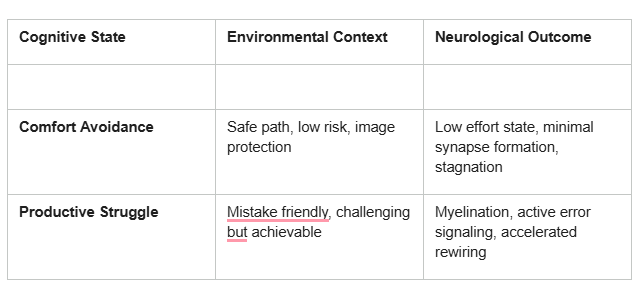
These signals act as neurological searchlights. They draw your sharp attention to the mistake and drive adaptive adjustments, helping the brain identify exactly what went wrong and how to improve next time. Failure forces your brain to build new connections to avoid repeating mistakes. Without that error signal, the brain stays asleep.
Step Into the Rain
Avoiding discomfort keeps the brain in a low effort state, limiting the activation of these adaptive mechanisms. In contrast, challenging tasks stress test your mind, pushing it to form new synapses and improve efficiency.
This is why creating mistake-friendly environments is so critical, whether for yourself, your children, or your team. When mistakes are treated as data rather than as judgments about your intelligence, individuals work harder and show bigger structural changes in the brain.
The next time you find yourself caught in a storm of challenge, change the questions you ask yourself. Do not ask how to escape. Lean into your superpower of choice, face the discomfort, and ask what you can learn. Your moments of failure do not define you. What you choose to do within those moments is what changes everything. So don’t run for cover. Stand in the rain.
The storms absolutely give us the ability to grow. Great message and wisdom, Brad!